
The Student’s t distribution is used in classical statistics for several purposes. One very common use is to test if the means of two sets of sampled values, where the two sample sizes are small (less than 30), are equal. For example, suppose you have a set of 20 test scores from males and 15 test scores from females. The average male score is 83. The average female score is 77. You can do a t-test to see if there’s statistical evidence that the two means are actually the same (and the observed difference of 6 points is due to chance).

You’d calculate a t statistic, which is a number like 1.543, from the data, and calculate something called df (degrees of freedom) which is a number like 18.307. Calculating these two numbers is not difficult. You feed the t value and df value to a special function that returns the probability that the two means are the same. This special function is called the cumulative density function of the t distribution. It’s not easy to calculate.
To code up the Student’s t density function, I used ACM Algorithm number 395. During the 1960s and 1970s the ACM published many algorithms. Here’s a screenshot of the relevant algorithm:
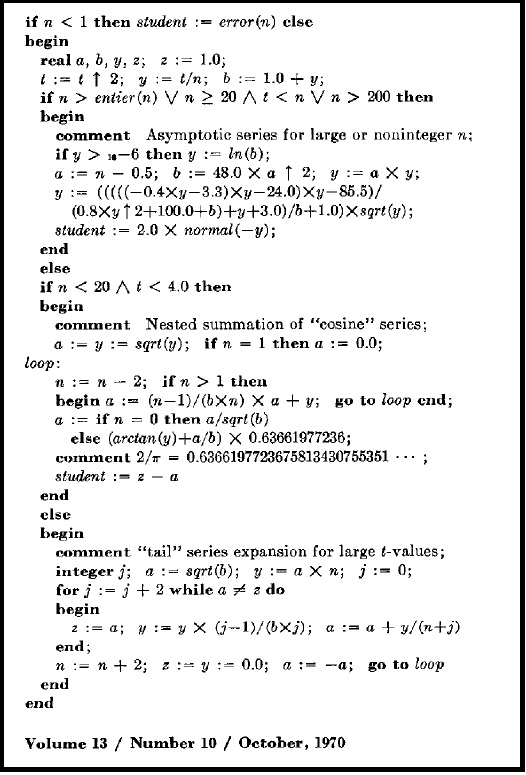
The ACM algorithm was quite strange. I implemented it using C#. The ACM version really has three variations. One is for use when df in a non-integer (i.e., type double) or df is a large integer. The second version is for when df is a small integer and t is a small (less than 4.0) value. The third version is for when df is a small integer and t is large (greater than 4.0).
Additionally, the ACM algorithm used some very wacky GOTO logic that I refactored. Algorithm 395 calls a helper function that returns the area under the Normal (Gaussian) curve. For that I used ACM algorithm number 209.
Here’s my implementation (with possible conversion-to-HTML errors related to the less-than and greater-than symbols):
public static double Student(double t, double df)
{
  // for large int df or double df

  // adapted from ACM algorithm 395
  // returns 2-tail probability

  double n = df; // to sync with ACM parameter name
  double a, b, y;

  t = t * t;
  y = t / n;
  b = y + 1.0;
  if (y > 1.0E-6) y = Math.Log(b);
  a = n - 0.5;
  b = 48.0 * a * a;
  y = a * y;

  y = (((((-0.4 * y - 3.3) * y - 24.0) * y - 85.5) /
    (0.8 * y * y + 100.0 + b) +
      y + 3.0) / b + 1.0) * Math.Sqrt(y);
  return 2.0 * Gauss(-y);
} // Student (double df)
public static double Student(double t, int df)
{
  // adapted from ACM algorithm 395
  // for small int df
  int n = df; // to sync with ACM parameter name
  double a, b, y, z;

  z = 1.0;
  t = t * t;
  y = t / n;
  b = 1.0 + y;

  if (n >= 20 && t < n || n > 200) // large df
  {
    double x = 1.0 * n; // make df a double
    return Student(t, x); // double version
  }

  if (n < 20 && t < 4.0)
  {
    a = Math.Sqrt(y);
    y = Math.Sqrt(y);
    if (n == 1)
      a = 0.0;
  }
  else
  {
    a = Math.Sqrt(b);
    y = a * n;
    for (int j = 2; a != z; j += 2)
    {
      z = a;
      y = y * (j - 1) / (b * j);
      a = a + y / (n + j);
    }
    n = n + 2;
    z = y = 0.0;
    a = -a;
  }

  int sanityCt = 0;
  while (true && sanityCt < 10000)
  {
    ++sanityCt;
    n = n - 2;
    if (n > 1)
    {
      a = (n - 1) / (b * n) * a + y;
      continue;
    }

    if (n == 0)
      a = a / Math.Sqrt(b);
    else // n == 1
      a = (Math.Atan(y) + a / b) * 0.63661977236; // 2/Pi

    return z - a;
  }

  return -1.0; // error
} // Student (int df)
public static double Gauss(double z)
{
  // input = z-value (-inf to +inf)
  // output = p under Normal curve from -inf to z
  // e.g., if z = 0.0, function returns 0.5000
  // ACM Algorithm #209
  double y; // 209 scratch variable
  double p; // result. called 'z' in 209
  double w; // 209 scratch variable

  if (z == 0.0)
    p = 0.0;
  else
  {
    y = Math.Abs(z) / 2;
    if (y >= 3.0)
    {
      p = 1.0;
    }
    else if (y < 1.0)
    {
      w = y * y;
      p = ((((((((0.000124818987 * w
        - 0.001075204047) * w + 0.005198775019) * w
        - 0.019198292004) * w + 0.059054035642) * w
        - 0.151968751364) * w + 0.319152932694) * w
        - 0.531923007300) * w + 0.797884560593) * y * 2.0;
    }
    else
    {
      y = y - 2.0;
      p = (((((((((((((-0.000045255659 * y
        + 0.000152529290) * y - 0.000019538132) * y
        - 0.000676904986) * y + 0.001390604284) * y
        - 0.000794620820) * y - 0.002034254874) * y
        + 0.006549791214) * y - 0.010557625006) * y
        + 0.011630447319) * y - 0.009279453341) * y
        + 0.005353579108) * y - 0.002141268741) * y
        + 0.000535310849) * y + 0.999936657524;
    }
  }

  if (z > 0.0)
    return (p + 1.0) / 2;
  else
    return (1.0 - p) / 2;
} // Gauss()
It was an interesting coding challenge.
 .NET Test Automation Recipes
 Software Testing
 SciPy Programming Succinctly
 Keras Succinctly
 R Programming
 2026 Visual Studio Live
 2025 Summer MLADS Conference
 2026 DevIntersection Conference
 2025 Machine Learning Week
 2025 Ai4 Conference
 2026 G2E Conference
 2026 iSC West Conference
You must be logged in to post a comment.